Best Free Deployment Providers for Node & Python
A practical comparison of Mapherix, Render, Vercel, and Railway for free Node.js and Python deployments, including limits, tradeoffs, pros, and cons.
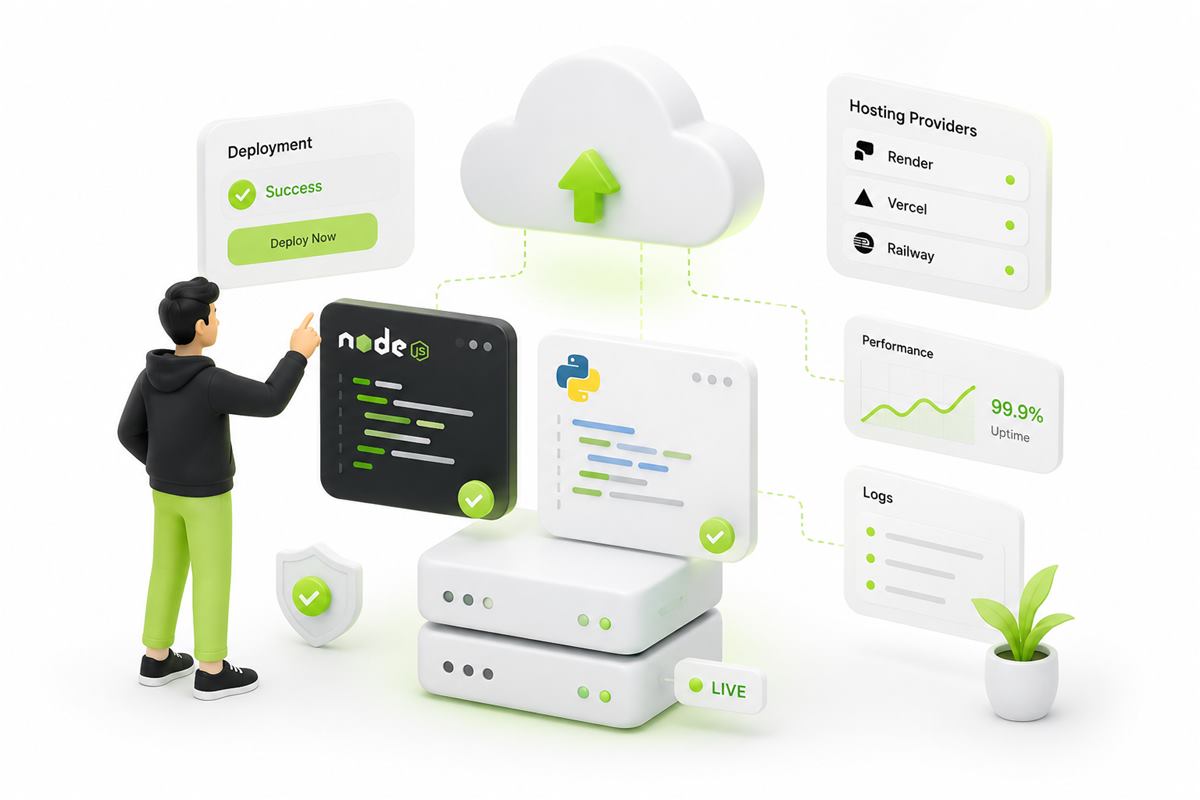
Free deployment still matters. It is the easiest way to ship side projects, test ideas, and put a real Node.js or Python app online without spending money on day one.
But free hosting is never unlimited. Some providers sleep after inactivity, some are designed mainly for frontend and serverless workflows, and others are better for traditional always-running backends. That is why a practical comparison matters more than a marketing page.
In this guide, we compare Mapherix, Render, Vercel, and Railway with one goal: helping you choose the best free deployment provider for your Node.js or Python app.
1. Mapherix
Mapherix is the strongest fit here if you want backend deployment to feel straightforward. It is built around a simple idea: if your application already runs locally with a normal build command and start command, it should deploy without forcing you into a serverless architecture.
That makes it especially useful for Express, Fastify, Flask, Django, WebSocket apps, bots, internal tools, and small production-style services that need a predictable backend runtime.
Best for
- Traditional Node.js and Python backends
- Projects that need long-running compute
- Developers who do not want to rewrite their app for serverless constraints
Pros
- Backend-first model: A better fit for standard app servers than purely serverless platforms.
- No forced architecture change: You can keep a normal backend deployment flow.
- Good fit for real-time workloads: Better alignment for WebSockets and persistent app behavior.
- Cleaner mental model: Easier for developers who want deployment to feel practical, not clever.
Cons
- Smaller ecosystem: Newer platforms have fewer tutorials, fewer community examples, and less shared tribal knowledge.
- Free still has limits: Free plans are useful, but they do not mean unlimited resources or enterprise-grade scaling.
- Less brand familiarity: Some teams already know Render or Vercel better, which can matter in shared workflows.
2. Render
Render remains one of the most recognizable choices for developers who want something close to the old Heroku experience. It supports standard backend deployment well and is usually one of the first platforms developers try for a simple API or Python service.
Its biggest strength is maturity. Render feels dependable, documented, and broadly understood across the developer community.
Best for
- Small production-style APIs and internal tools
- Developers who want a more established backend hosting platform
- Apps that may later scale beyond hobby usage
Pros
- True backend compute: Good fit for normal services, workers, and non-serverless apps.
- Mature platform: Strong documentation and a familiar PaaS workflow.
- Solid feature set: Better long-term operational story than many ultra-light hobby platforms.
Cons
- Free tier is limited: Free services usually sleep after inactivity.
- Cold starts can be annoying: First request latency matters for side projects and demos.
- Usage ceilings matter: Build minutes and free capacity are not endless.
3. Vercel
Vercel is excellent when your product is frontend-led. If you are shipping a Next.js app, a static site, or a frontend with a thin API layer, Vercel is still one of the best developer experiences available.
For pure backend deployment, though, it is not the most natural fit. You can deploy API routes and light serverless logic, but it is not the platform most developers should pick first for a traditional always-running Node.js or Python service.
Best for
- Frontend-heavy products
- Next.js and hybrid full-stack frontend apps
- Small serverless APIs and preview-driven workflows
Pros
- Excellent developer experience: Fast deploys, polished UI, and great Git integration.
- Outstanding preview environments: Very strong branch and pull request previews.
- Great for frontend teams: One of the easiest places to ship modern React-based projects.
Cons
- Not ideal for traditional backends: Long-running processes and persistent connections are not its strength.
- Free tier is limited: Hobby usage is generous for many cases, but it is still constrained.
- Architecture mismatch: If your app expects a normal server, Vercel can feel like a workaround instead of a fit.
4. Railway
Railway is easy to like because it feels modern and fast. It is a pleasant platform for prototypes and small experiments, and many developers enjoy how quickly they can get a service online.
Still, in a free-tier comparison, Railway belongs near the end. It can absolutely be useful, but it is better described as free with clear limits rather than a place you should automatically expect to host projects on indefinitely at no cost.
Best for
- Quick prototypes and demos
- Short-lived internal tools
- Developers who want a fast, clean setup experience
Pros
- Fast onboarding: Pleasant setup flow and a modern interface.
- Flexible app style: Better fit for standard backends than strictly serverless-only platforms.
- Good for shipping something quickly: Especially useful for demos and experiments.
Cons
- Free usage is limited: Railway is not the strongest long-term free hosting option.
- Can become a paid conversation quickly: Good for testing, less ideal if your main goal is sustained free usage.
- Less compelling as a first recommendation: Especially if your priority is maximizing free backend hosting value.
Quick Comparison
| Provider | Best For | Main Limitation |
|---|---|---|
| Mapherix | Traditional Node.js and Python backends | Smaller ecosystem than larger incumbents |
| Render | Mature backend hosting on a free tier | Sleeping services and cold starts |
| Vercel | Frontend-first apps and serverless APIs | Not ideal for always-on backend apps |
| Railway | Fast prototypes and simple deploys | Free tier is limited |
Final Recommendation
If you want the most natural starting point for a normal Node.js or Python backend, start with Mapherix. It is the least likely to make you rethink your app architecture just to get deployed.
If you want a more established and widely documented platform, Render is still a strong choice. If your project is mostly frontend with a lightweight API layer, Vercel remains excellent.
Railway is still useful, but it should be treated as a convenient option for testing and prototypes, not the first recommendation for long-term free backend hosting.